

Data Center Trends 2026: What IT Leaders Need to Know About Power, Cooling, and AI
The data center industry is in the middle of its most dramatic transformation in decades. Artificial intelligence (AI) workloads are fundamentally changing everything about how data centers are designed, built, and operated.
In 2026, the sector faces unprecedented momentum — driven by surging demand for AI, cloud, and edge computing, and the relentless pursuit of speed, efficiency, and sustainability .
This guide covers the ten most important data center trends for 2026, from megawatt-scale racks to liquid cooling breakthroughs, and explains what they mean for your business. Whether you operate your own data center, use colocation, or rely on hybrid cloud, these trends will shape your infrastructure decisions for years to come.

The Big Picture: AI Is Rewriting the Rules
Traditional data centers were designed for general-purpose computing: email servers, databases, and file storage. AI workloads are completely different. Training a large language model or running real-time inference requires massive parallel processing power from GPUs, which consume far more electricity and generate far more heat than traditional CPUs.
This shift is driving all major data center trends in 2026. Let’s examine them one by one.
Trend 1: The Rise of the Megawatt Rack
What’s happening: Legacy server racks typically drew 5–10 kilowatts (kW). In 2026, data center consultants are actively designing racks for 2.2 megawatts (MW) within a five-year timeframe . NVIDIA is preparing a 600 kW test unit (the “Rubin Ultra” Kyber rack) slated for release around summer 2027 .
Why it matters: This represents a 100x increase in power density in less than a decade. Traditional power and cooling architectures simply cannot handle these loads.
| Rack Density | Historical (Pre-2020) | Today (2026) | Near Future (2028-2030) |
| Typical range | 5–10 kW | 40–100 kW | 250 kW – 1 MW+ |
| Cooling method | Air cooling | Direct-to-chip liquid cooling | Immersion or two-phase liquid cooling |
| Power distribution | 208V/480V AC | Mixed AC/DC | 800V DC architectures |
| Typical workloads | Web servers, databases | AI training, large language models | Real-time AI inference, HPC |
What this means for you: If you are planning new data center capacity (whether on-premises or colocation), you must design for much higher densities than you think you need. Building for today’s 40 kW racks may leave you obsolete in three years.
Trend 2: Liquid Cooling Becomes Standard (Not Optional)
What’s happening: Air cooling cannot handle racks above 30–40 kW. As AI drives densities higher, liquid cooling has moved from experimental to industry standard. In 2026, direct-to-chip (DLC) liquid cooling is now the default for AI-centric deployments .
Major vendors are scaling up rapidly. nVent showcased 1.8 MW Coolant Distribution Units (CDUs) designed for NVIDIA’s reference architecture . Rittal demonstrated 1 MW direct-to-chip cooling pods capable of supporting densities up to 250 kW per rack .
Why it matters: Cooling accounts for up to 40% of data center energy use. Liquid cooling is dramatically more efficient than air cooling, reducing both energy bills and water consumption. It also allows for much higher compute density in the same physical footprint.
What this means for you: If you are deploying GPUs for AI workloads, liquid cooling is no longer a “nice to have.” It is a requirement. Ensure your colocation provider or facility offers DLC-ready infrastructure.
Trend 3: The Shift to 800V DC Power Architectures
What’s happening: Traditional data centers use alternating current (AC) power, which requires multiple AC-to-DC conversions inside each server. These conversions waste energy as heat. The industry is now preparing to shift to 800V direct current (DC) architectures that eliminate these conversion losses .
Major electrical vendors like LS Electric, Legrand, and ABB are actively prototyping solid-state transformers and DC-ready switchgear . Legrand’s Open Compute Project (OCP) power train centralizes AC-to-DC conversion at the rack level, pushing cabinet capacities toward 300 kW .
Why it matters: Every time you convert power, you lose efficiency. Eliminating multiple conversion steps can reduce electrical losses by 10-15%, which is enormous at hyperscale.
What this means for you: This trend is still emerging (widespread adoption may not hit until 2030) . However, new facilities should be designed with DC-ready pathways and the ability to upgrade. Ask your colocation provider about their DC power roadmap.
Trend 4: Grid Constraints Drive Hybrid Power Solutions
What’s happening: Electricity grids in many regions — including parts of California — cannot keep up with data center power demand. High-voltage grid connections in congested European markets face lead times of 6–8 years .
To solve this, operators are pivoting to on-site power generation using natural gas, with hybrid solutions combining renewables and gas as a “power couple” . According to Accenture, electricity grid constraints are driving a resurgence in natural gas for data center power, offering reliability and speed to market .
Why it matters: Data center growth is now constrained by power availability, not just capital or real estate. If your region lacks grid capacity, your expansion plans may be delayed by years.
What this means for you: When evaluating colocation providers, ask about their power sourcing strategy. Do they have on-site generation? What are their lead times for new capacity? Are they investing in renewable energy to meet sustainability goals?
Trend 5: Edge Data Centers Explode with 5G and IoT
What’s happening: The surge in 5G, AI, and Internet of Things (IoT) devices is driving explosive growth in edge data centers — smaller facilities located closer to users and devices to reduce latency .
Proximity to cities and industrial hubs is key, with modular solutions enabling fast deployment . Real estate strategies and last-mile resiliency are now central to competitive advantage .
Why it matters: Not all workloads can tolerate the latency of sending data to a centralized cloud region. Autonomous vehicles, industrial robotics, and real-time analytics require processing at the edge.
What this means for you: Evaluate which of your applications are latency-sensitive. Edge colocation may be a better fit than a centralized facility for manufacturing, retail, or healthcare workloads.
Trend 6: Cloud Repatriation Gains Momentum
What’s happening: After a decade of “cloud-first,” many enterprises are now moving workloads back from public cloud to colocation or on-premises environments .
The drivers are predictable: high egress costs, performance variability, and concerns about proprietary data being used to train public large language models (LLMs) . The “trillion-dollar paradox,” as Andreessen Horowitz described it, is forcing business leaders to face a hard truth: the cloud’s convenience often hides long-term cost and control tradeoffs .
Why it matters: For many workloads, colocation offers better total cost of ownership (TCO) and more predictable performance than the public cloud, especially for data-intensive applications like analytics and machine learning .
What this means for you: Conduct a workload-by-workload cost analysis. Cloud may still win for variable, spiky workloads. But for steady-state, high-volume processing, colocation is often more economical.
| Workload Type | Better Fit | Why |
| Spiky, unpredictable workloads | Public cloud | Elastic scaling, pay-as-you-go |
| Steady-state, predictable workloads | Colocation | Lower TCO, predictable costs |
| Data-intensive analytics | Colocation | No egress fees, predictable performance |
| Sensitive/proprietary data | Colocation | Full control over data residency and security |
| Development and testing | Public cloud | Agility and rapid provisioning |
Trend 7: Unified Software Tools Replace Fragmented Management
What’s happening: Data center operators have historically managed facilities using siloed tools: building management systems (BMS) for cooling, electrical power management systems (EPMS) for power distribution, and separate SCADA systems for rapid electrical switching .
This fragmentation creates complexity and delays. In 2026, vendors are consolidating these tools into unified, single-pane-of-glass software architectures . Schneider Electric’s “EcoStruxure Foresight” merges BMS, EPMS, and SCADA into one comprehensive system .
Why it matters: Unified management reduces mean time to repair (MTTR), improves energy efficiency, and helps prevent human error during critical operations.
What this means for you: When evaluating colocation providers, ask about their monitoring and management tools. Can you gain real-time visibility into power usage, cooling performance, and security alerts from a single dashboard?
Trend 8: Busbars Replace Traditional Power Cabling for Flexibility
What’s happening: As facility power densities surge, operators are moving away from permanent, end-to-end power cabling in favor of modular busbar trunking systems .
Busbars act as continuous, modular power panels that support loads up to 4,000 amps. They offer superior flexibility: you can tap off a new connection or reconfigure power routes without running a completely new cable from the main panel . Approximately 70% of new data center projects are now utilizing busbars in the gray space .
Why it matters: The initial capital expenditure for busbars is slightly higher than traditional cabling. However, the long-term operational flexibility — especially as rack densities evolve rapidly — far outweighs the upfront costs .
What this means for you: For any new data center or colocation deployment, specify busbar trunking for power distribution. Your future self will thank you.
Trend 9: Fiber Densification Accelerates for AI Clusters
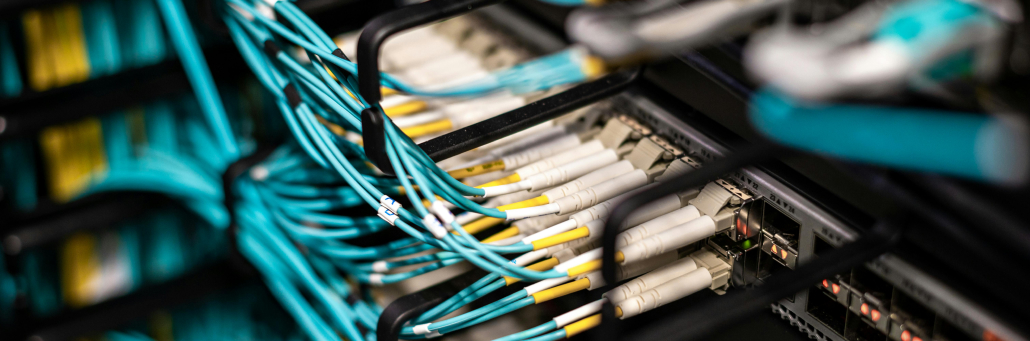
What’s happening: To support the massive data transfer rates required by AI GPU clusters, fiber optic cables are undergoing extreme densification . Fujikura demonstrated a cable containing 13,000 individual fibers using proprietary “rubbing tube” technology .
Why it matters: AI training requires constant communication between thousands of GPUs. Slow or congested networks waste compute cycles and increase training costs. Ultra-high-fiber-count cables are essential to prevent networking from becoming the bottleneck.
What this means for you: If you are building AI infrastructure, plan for significantly more fiber connections than you think you need. Structured cabling designed for today’s clusters may be insufficient for tomorrow’s.
Trend 10: Lead Times for Critical Components Remain Extended
What’s happening: Despite industry efforts to increase manufacturing capacity, lead times for many critical data center components remain extended .
| Component | Estimated Lead Time (2026) |
| High-voltage grid connections | 6–8 years (in congested regions) |
| High-voltage power cables | 1.5–2 years |
| Transformers and switchgear | 1–1.5 years |
| High-density fiber optic cables | 1–1.2 years |
| Standby generator engines | 1 year |
| High-density liquid cooling (1 MW) | 6 months |
Why it matters: Extended lead times mean that new data center capacity cannot be brought online quickly. If you are planning an infrastructure expansion, you need to start the procurement process much earlier than in the past.
What this means for you: Build long lead times into your project planning. Develop strong relationships with suppliers. Consider prefabricated, modular solutions that can be deployed faster than traditional builds.
Security Implications of 2026 Data Center Trends
As data centers evolve to support AI and higher densities, security must evolve too. Here are the key security considerations for 2026:
Physical Security Keeps Pace with Density
Higher rack densities mean more valuable equipment per square foot. Colocation facilities are enhancing physical security with biometric access controls, mantraps (interlocking doors that trap unauthorized individuals), 24/7 video surveillance, and on-site security personnel. Ask your provider about their physical security layers, certifications (e.g., SOC 2 Type II, ISO 27001), and visitor policies.
Liquid Cooling Introduces New Risk Vectors
Liquid cooling systems — while essential for AI workloads — introduce potential leakage risks. A coolant leak can damage servers just as badly as a water leak. Modern CDUs include integrated fluid-monitoring systems that detect leaks immediately and can automatically shut down affected zones . When evaluating liquid-cooled colocation, ask about leak detection, containment strategies, and maintenance procedures.
DC Power Architectures Require Specialized Safety Training
The shift to 800V DC power requires different safety protocols than traditional AC systems. DC faults do not self-extinguish the way AC faults do, requiring specialized training for on-site staff . Ensure your colocation provider’s engineering team has DC power expertise.
Hybrid Infrastructure Expands Attack Surface
As organizations adopt hybrid architectures (colocation + public cloud), the attack surface expands. Unsecured connections between environments can create vulnerabilities. Use dedicated, private cross-connects rather than public internet for cloud on-ramps. Implement consistent firewall and identity management policies across all environments.
Supply Chain Security for Critical Components
With extended lead times for components like fiber optic cables and transformers, there is increased risk of counterfeit or substandard parts entering the supply chain. Work with reputable vendors and ask about their supply chain security practices.
How Fireline Broadband Is Addressing 2026 Trends
Fireline Broadband’s Tier II+ data centers in Los Angeles and Orange County offer future-ready colocation with direct peering to major interconnection hubs.
At Fireline Broadband’s data centers, we are actively adapting to these data center trends:
- High-density ready: Our facility offers scalable power configurations to support evolving rack densities, with redundant A/B power feeds and N+1 cooling .
- Carrier-neutral connectivity: Direct fiber access to major interconnection hubs including Equinix LA1/LA4/LA5, and CoreSite LA .
- Hybrid-ready: We provide private cross-connects to major cloud providers, supporting hybrid and repatriation strategies .
- 24/7 security and support: Biometric access, mantraps, video surveillance, and on-site engineers (remote hands) ensure your equipment is protected and supported .
- Sustainable operations: Energy-efficient cooling and power management reduce environmental impact while controlling costs.
Whether you need traditional colocation, AI-ready high-density deployments, or a bridge to the public cloud, Fireline Broadband offers the infrastructure and expertise to support your 2026 data center strategy.
Ready to Future-Proof Your Data Center Strategy?
The data center industry is at an inflection point. AI is not just a new application — it is a fundamental shift in how computing infrastructure must be designed. From megawatt racks to liquid cooling to DC power, every layer of the stack is being reimagined.
For IT leaders, the message is clear: plan for higher density, expect longer lead times, and embrace hybrid architectures.
Fireline Broadband’s Los Angeles data center is ready to support your 2026 infrastructure needs, from traditional colocation to AI-ready high-density deployments
Call our business team:877-347-3147
Learn more about our Data Center Solutions
FAQs About AI Hosting
What is driving data center trends in 2026?
AI workloads are the primary driver. Training and running large language models, generative AI, and computer vision systems require far more power and cooling than traditional applications, forcing fundamental changes in data center design.
What is a megawatt rack?
A megawatt rack is a server rack that draws 1 MW (1,000 kW) or more of power. Traditional racks drew 5-10 kW. This massive increase is driven by dense GPU clusters used for AI training.
What is direct-to-chip liquid cooling?
Direct-to-chip liquid cooling circulates coolant through cold plates attached directly to GPUs and CPUs. It removes heat far more efficiently than air cooling and is becoming the standard for AI deployments.
What is cloud repatriation?
Cloud repatriation is the practice of moving workloads from public cloud back to colocation or on-premises environments, often driven by cost, performance, and control concerns.
Why are lead times for data center equipment so long?
High demand for AI infrastructure, global supply chain constraints, and limited manufacturing capacity for specialized components (e.g., high-voltage transformers, high-density fiber) have extended lead times significantly.
What is a busbar and why is it replacing cables?
A busbar is a solid metal conductor that distributes power within a data center. Unlike cables, busbars are modular and reconfigurable, allowing operators to add or move power connections without running new cables from the main panel.
How secure is colocation compared to on-premises?
For most businesses, colocation is more secure than on-premises. Professional colocation facilities have physical security (biometrics, mantraps, 24/7 guards) that is cost-prohibitive for a single company to implement on its own.
Is the public cloud going away?
No. The public cloud remains ideal for variable workloads, development and testing, and applications that benefit from elastic scaling. The trend is toward hybrid architectures that use both cloud and colocation for different workloads.
How can I prepare my business for these trends?
Conduct a workload-by-workload cost and performance analysis. Build long lead times into infrastructure planning. Design for higher power densities than you think you need. And partner with a colocation provider who is actively investing in AI-ready infrastructure.